


600HP Heavy Duty Bulldozer vs Standard Crawler Bulldozer: Key Differences
 Aug. 31, 2026
A 600HP Heavy Duty Crawler Bulldozer is designed for large-scale earthmoving, mining, quarrying, infrastructure, and severe site conditions, while a standard crawler bulldozer is usually built for general construction, roadwork, land development, and municipal projects. Buyers searching for this comparison usually want more than a horsepower difference. They want to know which machine will deliver the lowest cost per moved cubic meter, the best uptime, sufficient stability, manageable fuel consumption, and a practical return on investment.
This comparison focuses on the purchasing questions commonly raised in leading search results: working capacity, pushing force, fuel endurance, undercarriage life, operator control, transport requirements, maintenance, total ownership cost, and the type of buyer each machine best serves.

Start with the real difference between 600 horsepower and standard crawler power
Power changes production capacity, not only top-line specifications
The main advantage of a 600HP Heavy Duty Crawler Bulldozer is its ability to maintain pushing performance when the blade is heavily loaded, the soil is dense, the grade is steep, or the work area contains rock and compacted overburden. A standard crawler bulldozer may complete the same task, but it generally needs more passes, lighter blade loads, or support from additional machines.
- A 600HP machine is more suitable for high-volume pushing, ripping, stockpile management, large cut-and-fill operations, and mining production.
- A standard crawler bulldozer is more suitable for site preparation, utility construction, road maintenance, residential development, and moderate land clearing.
- Higher horsepower is valuable only when the job has enough material volume, working hours, and site access to use that capacity.
Operating weight and traction are equally important
Horsepower alone does not determine bulldozer performance. Operating weight, track width, blade configuration, transmission control, hydraulic output, and ground pressure all influence how effectively engine power reaches the ground.
A heavy machine can provide stronger traction and greater stability, but it can also create higher transport costs and greater ground pressure. A standard crawler bulldozer may be easier to move between sites and may perform better on sensitive ground where excessive machine weight causes rutting or surface damage.
Match production demand before choosing maximum power
The practical question is not whether 600 horsepower is better in isolation. The practical question is whether the project can keep a 600HP machine productive. If trucks, loaders, rippers, survey crews, or haul roads cannot support the bulldozer, the extra power may remain unused while ownership costs continue to rise.
For a short municipal project, a standard crawler bulldozer may provide a better return. For continuous mining or quarry production, the larger machine can reduce the number of passes and increase daily output enough to justify its purchase price and operating cost.
Compare the core parameters before comparing the brand name
Indicative specification comparison
Exact specifications vary according to manufacturer, blade type, ripper arrangement, operating configuration, emissions system, and regional requirements. The following table provides a practical purchasing range rather than a substitute for the final technical datasheet.
| Parameter | 600HP Heavy Duty Crawler Bulldozer | Standard Crawler Bulldozer | Purchasing meaning |
|---|---|---|---|
| Engine power | Approximately 550 to 650 HP | Approximately 150 to 350 HP | Higher power supports heavier loads and more demanding grades. |
| Operating weight | Often above 70 tonnes, depending on configuration | Often approximately 15 to 45 tonnes | Greater weight usually improves traction but raises transport requirements. |
| Blade capacity | Large-capacity straight, semi-U, or U blade options | Smaller straight, angle, semi-U, or U blade options | Blade selection must match material density and pushing distance. |
| Ground contact | Long and wide track configurations are common | More compact track configurations are common | Track design affects flotation, stability, wear, and turning performance. |
| Traction and drawbar pull | Very high, intended for severe resistance | Moderate to high, depending on class and configuration | Higher drawbar pull helps in hard soil, slopes, and deep cuts. |
| Hydraulic capacity | Designed for large blades and heavy attachments | Designed for standard blades and common attachments | Hydraulic flow and pressure determine attachment compatibility. |
| Fuel tank and work endurance | Large tank with high hourly fuel demand | Smaller tank with lower hourly fuel demand | Daily refueling depends on load, soil, idle time, and tank size. |
| Transport | Usually requires route planning, permits, and heavy haulage | Generally easier and less expensive to relocate | Transport cost should be included in project mobilization estimates. |
| Typical work scale | Mining, quarrying, major infrastructure, and large earthworks | Construction, roads, utilities, agriculture, and land development | The best machine is the one whose capacity matches the work cycle. |
Verify the specifications that affect production
Catalog horsepower is not enough for a reliable comparison. Ask the supplier to confirm the following data for the exact configuration being quoted:
- Net engine power and rated engine speed.
- Operating weight with the selected blade, ripper, counterweight, and track shoes.
- Blade width, blade height, blade capacity, and tilt or angle functions.
- Maximum drawbar pull and transmission operating modes.
- Hydraulic flow, hydraulic pressure, and attachment compatibility.
- Fuel tank capacity and expected fuel consumption under representative loads.
- Track shoe width, track frame design, ground pressure, and undercarriage component life.
- Transport dimensions, shipping weight, and disassembly requirements.
- Noise, emissions, safety, and operator visibility requirements in the target market.
Evaluate pushing performance, stability, and control in real working conditions
A heavy bulldozer is strongest when resistance is continuous
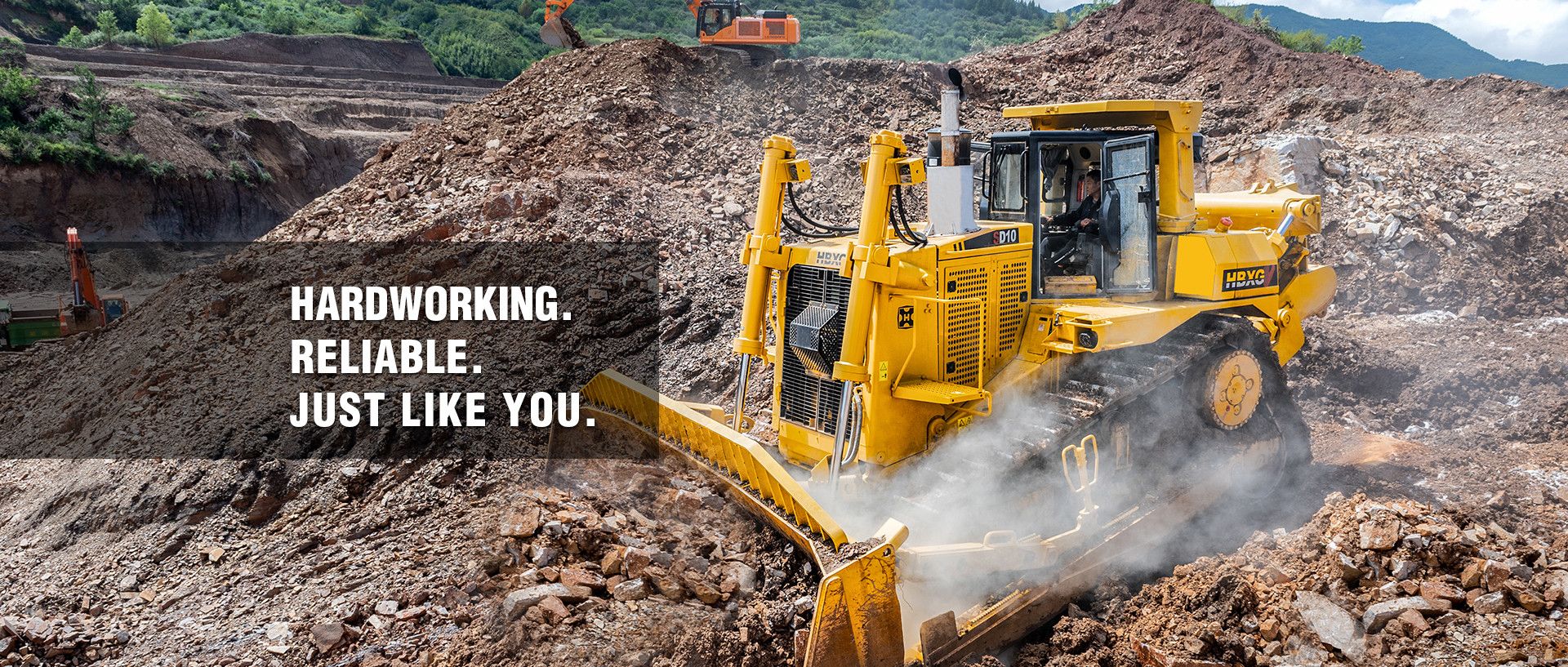
In actual use, a 600HP machine shows its value when the blade remains engaged with material for long periods. Dense clay, blasted rock, frozen ground, steep embankments, and large stockpiles create resistance that can slow a standard machine and increase the number of working cycles.
The heavy-duty machine can typically maintain a larger blade load and recover speed more effectively when entering a cut. This can improve hourly production and reduce the need for repeated repositioning.
Stability affects safety and finish quality
Stability is especially important on slopes, uneven benches, landfill faces, mine dumps, and large embankments. A heavier undercarriage and longer track footprint can help the bulldozer remain composed when pushing across irregular terrain.
- More operating weight can improve resistance to pitching and side movement.
- A longer track frame can improve longitudinal stability during uphill and downhill work.
- Wide shoes can reduce ground pressure but may increase wear or create more stress on the undercarriage if used on abrasive ground.
- Incorrect blade loading, excessive side slope operation, and poor work planning can make any bulldozer unstable.
Control quality matters as much as raw engine power
Modern operators expect predictable transmission response, smooth blade control, clear instrumentation, and precise low-speed movement. These features affect both production and fatigue. A machine that is difficult to modulate may waste fuel, damage the work surface, or place unnecessary stress on the drivetrain.
During a demonstration, observe whether the machine can start a heavy push smoothly, maintain a straight line, reverse without excessive delay, and make small blade adjustments without sudden hydraulic movement. These details often reveal more about daily usability than a horsepower figure.
Assess fuel endurance, battery performance, and daily operating cost
Fuel endurance is the main energy concern for a diesel bulldozer
Large crawler bulldozers normally use diesel engines rather than traction batteries. Therefore, the relevant endurance question is not electric battery life. It is how many productive hours the machine can work between refueling stops and how much fuel it consumes during those hours.
A 600HP bulldozer will usually consume substantially more fuel per hour than a standard crawler bulldozer because it has a larger engine, heavier structure, greater hydraulic demand, and higher potential production. That higher consumption can still be economical when the machine moves much more material per hour.
Calculate fuel cost per production unit
Hourly fuel consumption is useful, but fuel cost per cubic meter or per tonne is more meaningful. A smaller machine may burn less fuel per hour but require additional passes, longer working hours, and more machines to complete the same volume.
- Record fuel consumption during a representative work cycle.
- Measure material moved per hour, including maneuvering and repositioning time.
- Divide hourly fuel cost by productive output.
- Include idle time, warm-up time, refueling time, and operator breaks.
- Compare the result with the cost of using several standard bulldozers.
Use battery systems as a reliability and control consideration
Even diesel bulldozers depend on batteries for engine starting, electronic controls, monitoring systems, lighting, and auxiliary functions. Buyers should ask about battery capacity, cold-start performance, alternator output, battery isolation, charging access, and replacement intervals.
For remote operations, battery and electrical reliability can affect availability as much as fuel supply. A strong maintenance plan should include scheduled battery testing, clean terminals, correct charging voltage, protected wiring, and suitable cold-weather starting equipment where required.
Fuel efficiency depends on operating behavior
Continuous heavy pushing at full load naturally consumes more fuel than light grading. However, poor operating habits can make the difference much larger.
- Long idle periods increase fuel consumption without increasing production.
- Excessive spinning wastes fuel and accelerates track wear.
- Incorrect blade height can cause unnecessary resistance.
- Working downhill or using a push-pull plan can reduce energy demand.
- Regular air filter, fuel system, cooling system, and engine maintenance support fuel efficiency.
Compare durability, maintenance, and undercarriage life
Heavy-duty construction is valuable in abrasive environments
A 600HP Heavy Duty Crawler Bulldozer is normally expected to work long shifts in conditions containing rock, sand, overburden, debris, and high impact loads. Reinforced frames, heavy track components, protected hydraulic lines, strong blade structures, and suitable cooling systems can improve uptime in these conditions.
However, stronger components do not eliminate wear. Abrasive material can still damage track links, rollers, idlers, sprockets, cutting edges, blade corners, and ripper tips. The expected service life depends on ground conditions, operator technique, maintenance quality, and component inspection intervals.
Undercarriage cost can decide the purchase
The undercarriage is one of the most expensive wear systems on a crawler bulldozer. It also directly affects traction, stability, fuel consumption, and machine resale value.
- Inspect track link height, bushing wear, roller condition, idler alignment, and sprocket tooth shape.
- Select shoe width according to ground conditions rather than choosing the widest shoe automatically.
- Monitor track tension regularly because excessive tension increases wear and fuel demand.
- Remove packed mud, rock, and abrasive material from the track frame.
- Rotate or replace components according to measured wear, not only calendar time.
Maintenance access influences real uptime
Daily inspection points should be easy to reach. Engine oil, coolant, hydraulic oil, fuel filters, air filters, grease points, battery access, and diagnostic ports should not require excessive disassembly.
Before purchasing, ask to observe a routine service demonstration. A machine that saves one hour during every service interval can create substantial annual savings in a fleet working multiple shifts.
Support availability is part of machine durability
A durable bulldozer is not useful if replacement parts remain unavailable for weeks. Evaluate the supplier's regional warehouse, technical staff, service response time, warranty process, training program, and emergency support arrangements.
HBXG should be evaluated through the same practical criteria. Ask for the recommended spare parts list, service intervals, component warranty terms, training support, and local technician coverage before finalizing the purchase.
Compare the advantages and disadvantages of both bulldozer classes
Advantages of a 600HP Heavy Duty Crawler Bulldozer
- High pushing force for hard, dense, and abrasive material.
- Greater production potential on large sites.
- Strong stability on challenging grades and uneven terrain.
- Better ability to maintain blade load during continuous work.
- Suitable for large blades, heavy rippers, and demanding attachments.
- Potentially lower cost per moved cubic meter in high-volume operations.
- Long-term value for mining, quarrying, and major infrastructure contractors.
Disadvantages of a 600HP Heavy Duty Crawler Bulldozer
- Higher purchase price and financing requirement.
- Higher fuel consumption when working at similar light loads.
- More expensive transport, permits, and mobilization.
- Higher undercarriage, tireless track system, and attachment replacement costs.
- Greater site preparation requirements and possible ground damage.
- Need for trained operators and stronger maintenance infrastructure.
- Lower utilization risk if the contractor does not have enough large projects.
Advantages of a standard crawler bulldozer
- Lower purchase price and lower hourly fuel expense.
- Easier movement between construction and municipal sites.
- Good suitability for grading, backfilling, roadwork, and general site preparation.
- Lower ground pressure and easier operation on smaller sites.
- More accessible parts, technicians, and rental options in many markets.
- Lower financial risk for contractors with variable workloads.
Disadvantages of a standard crawler bulldozer
- Lower production in deep cuts, hard material, and large stockpiles.
- May require more passes or more machines to achieve the same output.
- Can lose momentum more easily when blade loads become excessive.
- May experience higher relative wear if continuously operated beyond its intended class.
- Less suitable for very large rippers, heavy pushes, and severe mine conditions.
Use a practical buying method based on the purchaser's pain points
Resolve the production uncertainty first
Many buyers are unsure whether the larger bulldozer will actually pay for itself. Request a production estimate based on the real material type, push distance, slope, blade configuration, working hours, and truck-loading cycle. Avoid relying only on a brochure production figure measured under ideal conditions.
A supplier should be able to explain the assumptions behind the estimate and identify which factors could reduce output. A site demonstration or monitored field test is more reliable than a general claim about horsepower.
Resolve the cost uncertainty with a total ownership calculation
Purchase price is only one part of the investment. Prepare a five-year or project-life estimate that includes:
- Purchase price, taxes, financing, and insurance.
- Fuel, lubricants, filters, and coolant.
- Operator wages and training.
- Undercarriage wear and replacement.
- Blade edges, ripper tips, and other wear parts.
- Scheduled maintenance and unscheduled repairs.
- Transport, permits, assembly, and relocation.
- Expected resale value and remaining service life.
- Production lost during downtime.
Resolve the availability concern before signing
Ask how quickly the supplier can provide common filters, seals, hoses, cutting edges, track components, sensors, and electrical parts. Also confirm whether technical manuals, service software, operator training, and remote troubleshooting are included.
For a remote mine or quarry, parts delivery and field support may be more important than a small difference in engine output. A slightly less powerful machine with dependable support can outperform a larger machine that remains idle while waiting for a component.
Resolve the operator concern with a supervised trial
Invite experienced operators to test both machine classes if possible. Ask them to evaluate visibility, blade response, transmission smoothness, reverse control, vibration, noise, seat comfort, access to service points, and ease of daily inspection.
Operator acceptance affects productivity, fuel use, safety, and retention. A machine that operators can control precisely is more likely to deliver its rated performance.
Select the right bulldozer for the right user group
The 600HP class is best for high-volume and severe-duty users
A 600HP Heavy Duty Crawler Bulldozer is generally appropriate for organizations with continuous, demanding work and the infrastructure to support a large machine.
- Large mining companies moving overburden, stockpiles, or waste material.
- Quarry operators working with blasted rock and abrasive ground.
- Major infrastructure contractors handling dams, highways, railways, ports, and airports.
- Large earthmoving contractors with long-term production contracts.
- Landfill and waste management operators requiring high pushing force and durable protection.
- Government or utility projects involving large-scale land formation and flood control.
A standard crawler bulldozer is better for flexible general contractors
A standard crawler bulldozer is usually a better fit for contractors who operate on smaller sites or perform a wide range of work with changing production requirements.
- Residential and commercial site developers.
- Road maintenance and municipal construction teams.
- Utility contractors performing trench backfill and site preparation.
- Agricultural and forestry users with moderate pushing requirements.
- Rental fleets serving customers with different project sizes.
- New contractors seeking lower initial investment and simpler logistics.
Consider fleet strategy instead of a single-machine decision
Some businesses will achieve better flexibility by combining machine classes. A heavy-duty bulldozer can handle primary pushes and severe ground, while standard crawler bulldozers can perform finish grading, cleanup, road maintenance, and smaller support tasks.
This approach can reduce idle time for the largest machine and keep smaller machines available for work that does not justify a 600HP unit. The correct fleet depends on annual utilization, project distance, rental availability, and maintenance resources.
Follow a final inspection checklist before purchase
Confirm the machine configuration
- Verify the exact engine model, net horsepower, emissions level, and cooling system.
- Match blade type and capacity to the material and push distance.
- Confirm whether the machine includes a ripper, winch, counterweight, cab protection, or specialized guards.
- Check operating weight and transport dimensions with every selected attachment installed.
- Review ground pressure and track shoe selection for the actual work surface.
Test the machine under load
- Start the engine from cold and check starting response, exhaust condition, and warning indicators.
- Operate the bulldozer forward and reverse at low and high working speeds.
- Push representative material with a realistic blade load.
- Check straight-line stability, turning response, and slope control.
- Operate the blade and ripper through their full hydraulic range.
- Inspect for abnormal noise, vibration, oil leakage, overheating, or delayed transmission response.
- Review fuel consumption and production output during the test.
Review the commercial terms
- Warranty duration and coverage for the engine, transmission, hydraulics, frame, and undercarriage.
- Parts availability and estimated delivery time.
- Technician response time and training arrangements.
- Recommended maintenance schedule and service labor requirements.
- Payment terms, delivery schedule, commissioning support, and export documentation.
- Resale expectations and availability of replacement wear parts.
Make the final decision by comparing cost per productive hour
Choose the 600HP machine when utilization is high
The larger bulldozer is usually the stronger choice when the project requires continuous high-load pushing, has sufficient material volume, and can support heavy transport and maintenance. Its higher operating cost can be justified when its production advantage reduces project duration, truck waiting time, or the number of support machines required.
Choose the standard machine when flexibility is more important
The standard crawler bulldozer is usually the better choice when projects are smaller, work conditions change frequently, transport access is limited, or annual utilization is uncertain. Its lower ownership cost and easier relocation can produce a better return even though its hourly production is lower.
Use measurable data rather than horsepower claims
Before purchasing, compare each machine using the same assumptions for material density, push distance, slope, operating hours, fuel price, maintenance cost, downtime, and resale value. This creates a clearer evaluation than comparing horsepower, blade size, or purchase price separately.
The best buying decision is the one that balances production capacity, fuel endurance, stability, operator comfort, maintenance access, parts support, transport, and total ownership cost. A properly selected HBXG bulldozer can be a strong long-term asset when its configuration and working class match the project. In the end, the right 600HP Heavy Duty Crawler Bulldozer is not simply the most powerful option. It is the machine that delivers dependable production at an acceptable cost for the users, site conditions, and operating hours involved.


